Hold the Line: A Field Guide to Britain’s Most Beautifully Pointless Queues
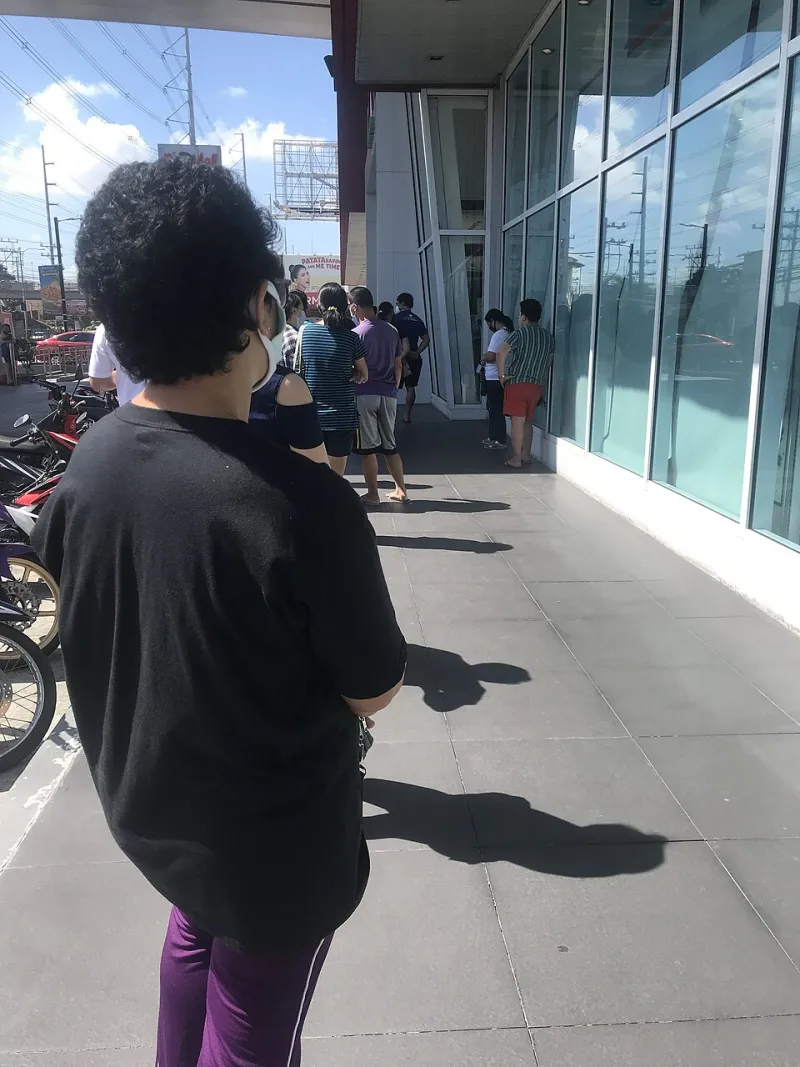
Photo: mycurrency.com, CC BY-SA 4.0, via Wikimedia Commons
On a grey November morning in 2026, I joined a queue outside a bakery in south London for a pastry I could not name and did not especially want. Forty minutes later I emerged with a cardamom bun, a mild sense of victory and no clear explanation for either. This, I think, is the true British sport.
We are a nation that will form an orderly line for almost anything: a limited-edition sandwich, a new charity shop, a signing by a minor television gardener, a pop-up selling candles that smell of wet dog and ‘heritage’. The queue is not the obstacle. The queue is the event.
The Queue Games: an entirely unofficial programme
Nobody organised the Queue Games. There is no committee, no mascot and no drug testing, unless you count the heroic consumption of flask coffee. But if there were, these would be the blue-riband events.
The Bakery 40. Competitors must stand outside an artisan bakery for at least forty minutes, despite having walked past a perfectly good Greggs on the way. Points are awarded for pronouncing ‘pain au chocolat’ with confidence and for not asking why the croissant costs £4.80.
The Charity Shop Dash. This is not a dash. Nobody dashes. The event begins at 8.55am outside a newly opened charity shop, where thirty people quietly wait to inspect the same three soup tureens. The winner is the first person to say ‘I saw that first’ without sounding uncharitable.
The Post Office Shuffle. A technical discipline involving tickets, sighs and the pretence that you are not listening to someone’s parcel-related drama. See below for the full rules.
The Pop-Up Pilgrimage. A queue for something that will exist for three weeks and then vanish, leaving only a Instagram grid and a faint smell of sourdough. Competitors must pretend they have been fans since the beginning, even though the beginning was last Tuesday.
The Sample Spoon Scurry. Found at food markets, where a queue forms for a thimble of chilli oil or a cube of cheese on a cocktail stick. The prize is another cube of cheese. The crowd goes wild.
The Inexplicable Join. The purest event. A queue forms for no visible reason. A passer-by joins it. Another follows. Within ten minutes, forty people are waiting for something that turns out to be a collapsed road sign. Nobody leaves, because leaving would imply they had somewhere better to be.
Meet the competitors
Doreen, 71, from Wolverhampton, is a veteran. ‘I’ve queued for a bakery opening, a cheese shop and a Santa’s grotto in the same month,’ she says. ‘The grotto was rubbish. The cheese was worth it. You learn to read a queue.’ Her advice for beginners? ‘Take a snack. Not from the queue. That’s bad form.’
Callum, 29, from Bristol, describes himself as ‘queue-curious’. He once joined a line outside a record shop because the people at the front looked interesting. ‘I didn’t own a record player,’ he admits. ‘I bought a tote bag and left. Best forty-five minutes of my week.’
Maureen, 63, from Stockport, queues for charity-shop openings with a folding stool and a flask. ‘It’s not about the shopping,’ she says. ‘It’s about the chat. You see the same faces. We’ve got a little community now. We call ourselves the Early Birds, even though most of us are retired.’
The post-office shuffle
The post office is where the British queue reaches its highest artistic form. It is not a line. It is a choreography.
You enter, assess the room, and take a ticket from the machine with the quiet dignity of someone who has done this before. You sit down. You pretend to read a leaflet about travel insurance. You watch the screen. You watch the screen. You watch the screen. Somebody’s number is called. Nobody moves. Then somebody moves. Then somebody else moves. Then the person whose number it actually is moves.
There is a particular sigh that belongs to the post-office queue. It is not an angry sigh. It is a resigned, communal sigh, a small exhale that says: yes, this is happening, and yes, we are all in it together. It is almost cosy.
Why do we do it?
Because a queue is a temporary village. It has a beginning, a middle and an end. It has hierarchy, gossip, minor villainy and occasional heroism. It has that one person who keeps edging forward, and that other person who keeps saying ‘I think we’re all in the same boat’ in a tone that suggests they would like to push the edger into a canal.
A queue is also a fairness machine. It says: whatever this is, we will not let the loudest or the richest or the tallest get it first. We will stand here, in the drizzle, and we will take our turn. It is a small, stubborn act of optimism.
And then there is the strange alchemy of desire. I did not want a cardamom bun at 9.02am. By 9.42am, I would have fought a celebrity chef for it. The queue had created scarcity where none existed. The queue had made the bun meaningful. The queue, in short, had done a number on me.
The unwritten rules
Do not ask what the queue is for until you have been in it for at least ten minutes. Asking early is like reading the last page of a novel.
Maintain the two-foot gap. Too close is aggressive. Too far is an invitation for someone to assume you are not really in the queue and step in front of you with a cheerful ‘sorry, didn’t see you there’.
Do not announce that you ‘might leave it’. You will not leave it. Everyone knows you will not leave it.
If someone saves a place for a friend, the friend must arrive within five minutes and must not bring a list of complicated orders. This is the social contract.
Accept that the queue may end in disappointment. The bakery may sell out. The charity shop may have nothing but a jigsaw with a missing piece. The pop-up may be closed due to ‘unforeseen circumstances’, which is queue-speak for ‘we sold out and went to the pub’.
A modest proposal
Could we formalise the Queue Games? A laminated card? A local league table? A trophy shaped like a thermal mug? Perhaps not. The beauty of the British queue is that it is pointless, temporary and entirely self-organised. It is a bit of nonsense we all agree to perform, in public, for no good reason.
So next time you see a line of people waiting for something mysterious, do not scoff. Join them. You might get a bun. You might get a chat. You might get forty minutes of standing about in the cold, wondering why you are there. And honestly, that is the most British prize of all.