Cul-de-Sac Navidad: Inside Britain’s Great Christmas-Light Bragging War
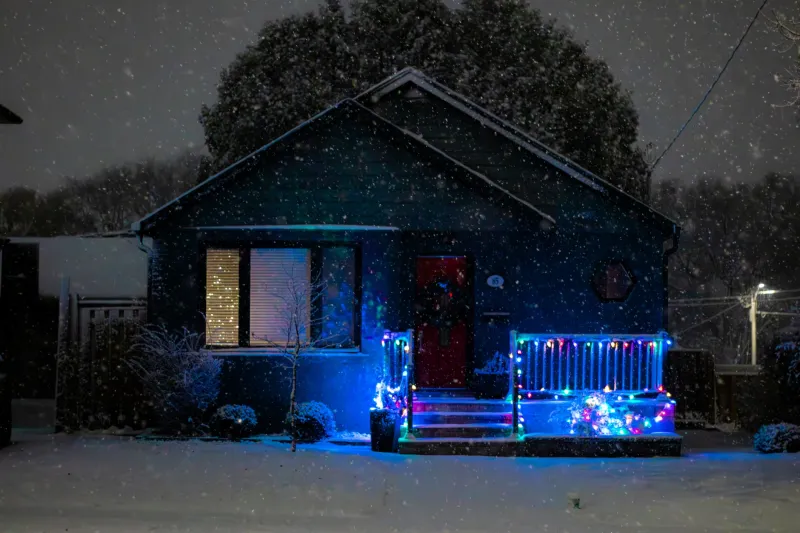
There is a moment, usually on a damp Tuesday in mid-November, when a perfectly ordinary British cul-de-sac changes. One neighbour puts up a single wreath. Another responds with icicle lights. Within a fortnight, a third has inflated a Santa the size of a garden shed, and somebody’s hedge is flashing in time to ‘Fairytale of New York’. By December, the street has become a drive-through attraction with worse parking and a WhatsApp group that reads like a NATO summit.
This is not merely decoration. It is diplomacy, one-upmanship and municipal admin, all wrapped in tinsel. Welcome to the great suburban Christmas-light bragging war.
How a cul-de-sac becomes a regional attraction
The escalation follows a predictable pattern. Phase one is tasteful. A wreath, perhaps a small lit reindeer, the sort of display that says ‘I am festive but emotionally restrained’. Phase two arrives when somebody spots a neighbour’s icicles and feels a deep, irrational need to go bigger. Phase three involves an inflatable, an extension lead and a quiet vow that next year will be ‘properly done’.
By phase four, the street has a reputation. People slow down in their cars. Children point. A coach party from a nearby village arrives and someone’s nan asks if there is a bucket for charity. The original wreath neighbour now looks like a minimalist who has accidentally joined a panto.
The timers are where it gets personal. One household sets its lights to come on at 4.47pm. The house opposite chooses 4.46pm. Nobody admits this is deliberate, but everyone knows. It is passive-aggression in LED form, and it is glorious.
The economics of showing off
There is a curious financial logic to the festive arms race. Everyone insists the display is ‘for the kids’, even when the only child on the street is a nineteen-year-old who has gone to university. Everyone claims LEDs have made it cheap, which is true until you remember that LEDs have simply allowed people to buy four times as many of them.
The energy bill conversation is delicately handled. You do not ask a neighbour outright what their display costs, any more than you ask what they paid for their car. Instead, you hover near the meter cupboard and say something like ‘Must be lovely having all those lights on, I bet it’s not too bad these days’. The neighbour will say ‘Oh, it’s all LED, pennies’, and everyone will nod as though this settles the matter.
In 2026, the canniest displays lean into the energy-aware mood. Warm-white LEDs, solar path lights and a timer that clicks off at a respectable hour suggest virtue as well as sparkle. The least canny displays feature a generator humming behind a hedge and a soundtrack audible three streets away. There is a fine line between community spirit and a low-level noise complaint.
Councils, cables and the great extension-lead treaty
Local councils have to perform a delicate dance. They do not want to be the Grinch who cancels Christmas, but they also have to think about trip hazards, cables across pavements and bin lorries that cannot squeeze past an inflatable snowman. Most authorities take a softly-softly approach: safety advice, a reminder about outdoor-rated equipment, and a quiet word if a display starts affecting the road.
On the street itself, the real governance comes from the WhatsApp group. This is where the Lights Czar emerges: the neighbour who knows about timers, owns a label maker and has strong views on cable management. They will propose a ‘switch-on evening’ with mulled wine and a charity bucket. They will also send a message at 11.14pm asking whose inflatable is still going, because some of us have work in the morning.
The etiquette is unwritten but firm. Do not unplug a neighbour’s lights, even if they are flashing in a pattern that could trigger a migraine. Do not reposition someone else’s Santa without permission. Do contribute to the charity bucket if you are benefiting from the glow. And if the Lights Czar asks for a ‘small contribution towards the electric’, ask politely what it covers before handing over a tenner.
The 2026 verdict: best and worst trends
Best: warm-white, low-wattage displays that look like a Jane Austen adaptation rather than a gaming rig. Smart timers that respect the 10.30pm off-switch. Solar-powered path lights that do a modest job without drama. Street-wide charity switch-ons where the bucket is for a local hospice and the mulled wine is not compulsory. And anything repaired rather than replaced, because a second-hand lit reindeer has more soul than a brand-new inflatable grotto.
Worst: the 12-foot inflatable ‘Winter Wonderland Grotto Experience’ that requires its own generator and blocks the pavement. Projectors that throw snowflakes onto a neighbour’s house without asking. Synchronised soundtracks that turn a quiet residential street into a low-budget outdoor festival. And the ‘AI Santa’ that greets you by name, which is either clever or deeply unsettling depending on how much you enjoy being watched by a plastic beard.
Surviving the street’s self-appointed Lights Czar
First, know your role. Are you a Decorator, a Reluctant Participant or a Quiet Resistor? All are valid, but only one of you will end up on the WhatsApp group’s ‘lighting committee’.
Second, agree a timer window early. This is the single most effective peace treaty available. Lights on at dusk, off by 10.30pm, no flashing sequences after 9pm unless it is a genuine emergency involving Santa’s sleigh.
Third, keep it safe. Outdoor-rated cables, an RCD plug, no cables across the pavement, and no daisy-chaining so many extension leads that the hedge becomes a fire risk. The council will not thank you, and nor will the hedge.
Fourth, compliment generously and compete gently. A simple ‘Your reindeer looks brilliant’ costs nothing and buys you enormous goodwill when your own inflatable penguin starts deflating at 2am.
Finally, remember the point. The best displays are the ones that give something to the street without demanding a round of applause. The worst are the ones that turn a cul-de-sac into a scoreboard. If you can make a neighbour smile, a child point and the bin lorry still get through, you have won the arms race. Probably.