Halo Fails and Hot-Glue Heroes: Britain’s Nativity Costume Scramble Enters Its Chaos Era
It is 12 November 2026, and somewhere in Britain a reception-class parent has just read the words “can your child come as a shepherd” and felt a small, specific dread. Not war, not taxes — a tea towel. The school nativity costume panic is back, and this year it has arrived with the quiet menace of a letter that says “a simple costume is fine” while secretly demanding a fully realised theatrical production by 9am next Thursday.
Every November, the same ritual unfolds. Book bags disgorge a photocopied note. A WhatsApp group stirs. A grown adult stands in a supermarket aisle at 8:47pm holding a pack of white face paint and a tinsel halo, questioning every life choice that led them here. And somewhere else, a child is calmly eating a biscuit, entirely unbothered by the fact that their costume currently consists of a bin bag and a prayer.
The letter lands: a masterclass in vague hope
The nativity letter is a beautiful piece of British understatement. It will use the phrase “no need to go to any expense” and then, three lines later, request “a simple donkey headpiece, ideally with moving ears”. It will suggest “something from the dressing-up box” to parents who know full well the dressing-up box contains one eyepatch, a plastic sword and a deflated Spiderman suit with a mysterious stain.
Within minutes of the letter landing, the school-gate economy shifts. Parents who claim to be “not creative” begin sketching costume plans on the back of an envelope. Parents who are genuinely not creative begin searching “shepherd costume next day delivery” with the desperation of a wartime codebreaker. And a small, noble minority decide their child will be a “star” because a star can, at a push, be a piece of cardboard covered in tinfoil.
The WhatsApp amnesty: a black market in felt and goodwill
By day two, the class WhatsApp group has become a costume amnesty. “Anyone got a donkey head going spare?” “I’ve got sheep ears from 2024 if that helps.” “Does anyone know where to buy a single tea towel that looks biblical?” It is part charity shop, part hostage negotiation, part mild social jostling. Someone will offer a “gently used angel wings” and someone else will reply “yes please” within four seconds, because angel wings are the gold standard of the nativity supply chain.
But be warned: the amnesty has a hierarchy. The parent who offers a full shepherd’s croft, a tea towel of the correct weave and a “spare beard if needed” is not merely helping. They are establishing a quiet reputation. They are the Lord Sugar of the school gate. They will never mention it again, but everyone will know.
The 9pm supermarket dash: where dignity goes to die
The late-night supermarket run is the beating heart of the nativity panic. You will go in for a tea towel and come out with three metres of gold tinsel, a pack of pipe cleaners, a glue stick and a bag of sprouts because they were reduced. The festive aisle is a battlefield of other parents, all avoiding eye contact, all clutching the same generic “Christmas character” accessory set.
This is where the hot glue gun becomes a personality trait. You will see people who have not crafted since primary school suddenly discussing the structural integrity of a tinsel halo. You will hear someone say “I’ll just run it up on the machine” and feel a small, quiet shame about your own sewing abilities, which extend to “can sew on a button if pressed”. And you will witness the beautiful British compromise: a child dressed as a shepherd with a fluorescent yellow high-vis vest under the tea towel, because “it’s cold in the hall”.
The school-gate costume Olympics
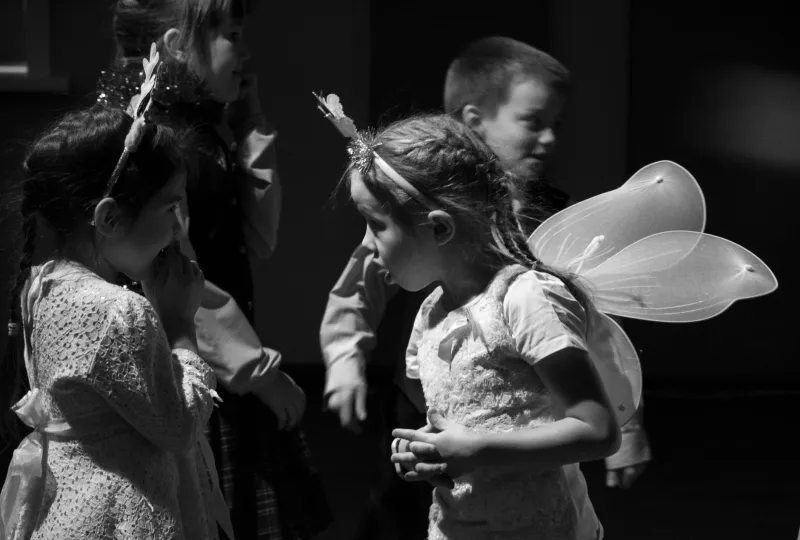
On the morning of the nativity, the school gate becomes a low-stakes fashion week with high-stakes social consequences. There are the tea-towel shepherds, noble and slightly dishevelled, their headdresses held on with a hair bobble and hope. There are the tinsel angels, trailing glitter like a crime scene. There are the donkeys made from grey hoodies and felt ears, and the stars made from cardboard and an unwise amount of spray paint.
And then there is the parent who has clearly started in September. Their child is wearing a hand-stitched robe with a braided belt and a crook made from a real branch. They will say “oh, it was nothing” and you will smile and say “it looks lovely” while internally drafting a strongly worded letter to the school about unrealistic expectations. But here’s the thing: the child will not care. The child will care about whether they get to hold the star, whether their friend is standing next to them, and whether there are biscuits afterwards. The costume is for us, really. The panic is ours.
A survival kit for the mildly unhinged
- Read the letter properly. If it says “simple”, believe it. If it says “no need to buy anything”, that is a trap, but a well-meaning one.
- Raid the airing cupboard first. A tea towel, a white sheet and a belt can get you a shepherd, an angel or a wise man with minimal shame.
- The costume amnesty is real. Ask in the WhatsApp group. Someone has a donkey head in a loft. They have been waiting for this moment.
- Hot glue is your friend. It is also the enemy of soft furnishings, but we move.
- Label everything. The nativity costume graveyard is full of unnamed tinsel halos and forgotten sheep ears.
- Lower your standards. The child will remember the biscuits, not the braiding.
The tinfoil halo truth
The school nativity costume panic is ridiculous, yes. It is also a strangely wholesome national ritual. It gets grown adults talking to each other in supermarket queues. It turns a tea towel into a symbol of parental effort. It allows us to be mildly competitive in a way that is mostly harmless and occasionally very funny.
So as 2026’s nativity letters land in book bags up and down the country, spare a thought for the parent currently hot-gluing a halo at 10pm. They are not just making a costume. They are participating in one of Britain’s great amateur theatre traditions: the annual proof that we will do almost anything for our children, as long as it can be finished with a bit of tinsel and a strong cup of tea.